
If you are a foreign investor entering Sri Lanka, one of the first decisions you will face is:
Should you register under BOI or set up a standard company?
This is not just a legal step. It directly affects:
Many investors assume BOI is automatically better. That assumption leads to poor decisions.
Before making a decision, it is worth understanding how businesses actually enter the market. A clear breakdown of this can be found in this guide on setting up a company in Sri Lanka, which outlines the real process beyond registration.
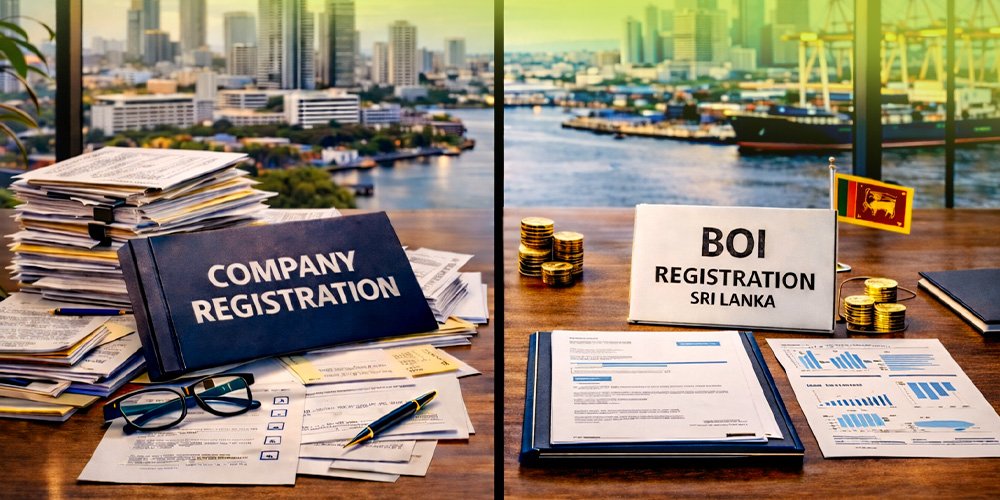
BOI refers to the Board of Investment of Sri Lanka.
It is a government authority that promotes foreign investment by offering targeted incentives.
However, these benefits are not guaranteed.
You only receive them if your business:
For companies planning long-term operations, the structure must also align with financial discipline. This becomes clearer when you look at how financial controls should be set before launching operations in Sri Lanka.
A standard company is registered through the Registrar of Companies Sri Lanka under standard commercial law.
This structure is often preferred by companies building operational offices, especially those prioritising control and scalability over conditional incentives.
BOI vs Standard Company Sri Lanka: Key Differences
|
Factor |
BOI Company |
Standard Company |
|
Setup Time |
Slower |
Faster |
|
Tax Incentives |
Available (conditional) |
Not available |
|
Flexibility |
Limited by agreement |
High |
|
Compliance |
Higher |
Standard |
|
Approval Required |
Yes |
No |
|
Best Fit |
Large investments |
Flexible operations |
Here is the direct answer:
The real difference is simple:
BOI gives potential advantages with restrictions.
Standard companies give control without incentives.
BOI is not for everyone.
Many modern businesses entering Sri Lanka focus more on efficiency and measurable outcomes. This is why understanding the real ROI of an extended office model becomes important when evaluating your structure.
This is one of the most searched questions by foreign investors.
If speed to market matters, this difference alone can influence your decision.
This is where most investors underestimate the impact.
If your business is lean, high compliance can slow execution more than it adds value.
Everyone talks about tax savings. Almost no one talks about eligibility risk.
In many cases, predictable financial structures outperform uncertain incentives over the long term.
Yes, in most sectors.
Foreign investors can fully own both:
However, sector-specific restrictions may apply depending on the industry.
This is another high-intent question.
At first glance:
But in reality:
A standard company may appear more expensive on paper, but often delivers better operational efficiency and faster returns.
In practice, many companies operating in Colombo prefer standard structures.
Why?
This reflects a shift towards control, governance, and scalability, rather than purely tax-driven decisions.
They optimise for tax first, instead of structure first.
This leads to:
A better approach is to align your structure with how you plan to operate.
How to Decide the Right Option
Ask yourself:
If you cannot clearly justify BOI, it is not the right choice.
This is not just a registration decision.
It is a strategic decision that defines how your business operates, scales, and manages risk in Sri Lanka.
Choosing BOI without alignment creates friction.
Ignoring it when relevant means missing real advantages.
If you get this decision wrong, you do not just lose tax benefits.
You lock your business into a structure that slows growth, increases compliance pressure, and limits control.
Most foreign companies realise this too late, after setup.
Do not make that mistake.
If you are planning to enter Sri Lanka, get your structure right before you register.
Talk to Envoy Ortus Plus and build a setup that gives you control, compliance clarity, and long-term scalability, not just short-term assumptions.
👉 Start your consultation today and make the right decision from day one.